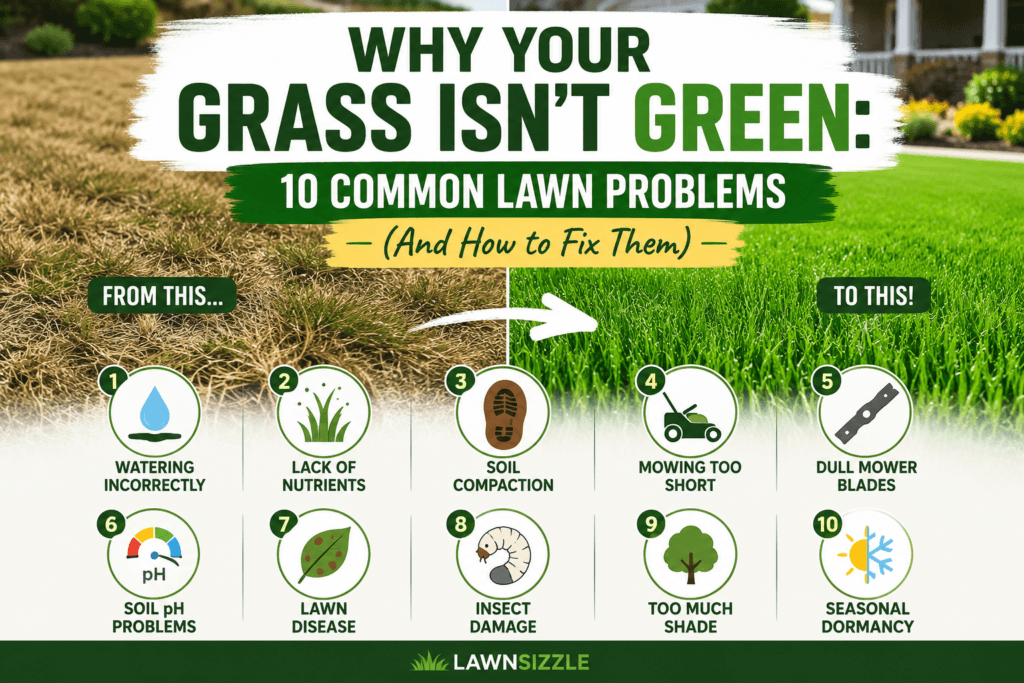
 Why Your Grass Isn’t Green: 10 Common Lawn Problems (And How to Fix Them)
Growing a rich, green lawn doesn’t have to be a mystery. If your yard looks yellow, patchy, or brown while your neighbors enjoy lush green grass, there’s usually a specific reason—and most lawn problems are easier to fix than you might think.
The key is identifying the cause before spending money on fertilizers or lawn treatments that may not solve the issue. In this guide, we’ll walk through the 10 most common reasons your grass isn’t green and explain exactly what you can do to bring your lawn back to life.
1. You’re Watering Too Much—or Too Little
Watering mistakes are one of the biggest reasons lawns lose their healthy green color.
Many homeowners water every day for just a few minutes. While that seems logical, it actually encourages shallow roots that struggle during hot weather.
Instead, aim for deep, infrequent watering. Most established lawns need about 1 to 1½ inches of water per week, including rainfall. Watering early in the morning also helps reduce evaporation and lowers the risk of lawn disease.
Signs of underwatering
- Grass turns bluish-gray
- Footprints remain visible after walking
- Dry, brittle blades
Signs of overwatering
- Mushy soil
- Fungal growth
- Yellowing grass despite frequent watering
2. Your Lawn Needs More Nitrogen
Nitrogen is responsible for the rich green color most homeowners want. When your lawn lacks nitrogen, it often becomes pale, yellow, or slow-growing.
A quality lawn fertilizer with slow-release nitrogen can dramatically improve color over several weeks while encouraging steady, healthy growth.
Always follow the application rate listed on the fertilizer bag. Applying too much can damage your lawn and increase the risk of runoff into nearby waterways.
3. Your Soil Is Compacted
Even healthy grass struggles when its roots can’t breathe.
Heavy foot traffic, children playing, pets, and mowing equipment gradually compact the soil, making it difficult for water, oxygen, and nutrients to reach the roots.
Common signs include:
- Water puddling after rain
- Thin grass
- Hard soil that’s difficult to push a screwdriver into
Core aeration relieves compaction by removing small plugs of soil, allowing roots to grow deeper and healthier.
4. You’re Mowing Too Short
Many homeowners believe cutting grass shorter means mowing less often. Unfortunately, this weakens the lawn and exposes the soil to heat.
Never remove more than one-third of the grass blade during a single mowing. Do this by raising your mower to its highest setting, and leaving it there.
Keeping your grass slightly taller:
- Shades the soil
- Helps retain moisture
- Reduces weed growth
- Encourages deeper root systems
A taller lawn almost always looks greener than one that’s scalped every weekend.
5. Your Mower Blade Is Dull
A dull mower blade tears grass instead of cutting it cleanly.
Those torn tips quickly dry out, leaving your lawn with a brown or whitish appearance—even if the grass is healthy.
Sharpen mower blades every 20–25 hours of mowing or at least once each growing season. The difference in lawn appearance can be dramatic.
6. Your Soil pH Is Out of Balance
Grass absorbs nutrients most efficiently within a certain pH range.
If the soil is too acidic or too alkaline, your lawn may struggle even after fertilizing.
A simple soil test can tell you:
- Soil pH
- Nitrogen levels
- Phosphorus levels
- Potassium levels
- Organic matter content
Knowing these numbers allows you to treat the real problem instead of guessing.
7. Lawn Disease May Be Taking Over
Fungal diseases often begin as small yellow or brown patches before spreading across the lawn.
Common diseases include:
- Brown Patch
- Dollar Spot
- Rust
- Leaf Spot
Many fungal problems develop because of excessive moisture, poor airflow, or watering late in the evening.
Improving watering habits and mowing practices often prevents future outbreaks. Severe infections may require a fungicide labeled for your specific lawn type.
8. Insects Could Be Damaging the Roots
Some insects feed directly on grass roots, causing sections of the lawn to die.
- White grubs
- Chinch bugs
- Armyworms
- Sod webworms
If brown patches lift easily like loose carpet, grubs may be the culprit.
Inspecting the soil before applying treatments helps ensure you’re solving the correct problem.
9. Your Lawn Doesn’t Get Enough Sunlight
Most turfgrass varieties need at least six hours of direct sunlight each day.
If large trees or nearby buildings create constant shade, the grass may remain thin regardless of how much fertilizer or water you apply.
Possible solutions include:
- Pruning tree branches
- Overseeding with shade-tolerant grass varieties
- Creating landscape beds in areas where grass simply won’t thrive
Sometimes the best lawn decision is recognizing where grass isn’t the right plant.
10. Your Grass May Simply Be Dormant
Brown grass isn’t always dead.
Many warm-season grasses naturally enter dormancy during cooler months, while cool-season grasses may temporarily go dormant during periods of extreme summer heat.
Dormant grass usually:
- Turns tan or light brown
- Has firm roots
- Returns to green once favorable temperatures return
Knowing your grass type helps prevent unnecessary treatments.
A Simple 30-Day Lawn Recovery Plan
If your lawn has lost its healthy green appearance, start with these basic steps before buying expensive lawn products.
Week 1
- Measure how much water your lawn receives.
- Raise your mower height.
- Inspect for insects or disease.
Week 2
- Apply a balanced fertilizer if your lawn needs nutrients.
- Sharpen your mower blade.
Week 3
- Perform a soil test.
- Spot-treat weeds or disease if necessary.
Week 4
- Consider core aeration if your soil is compacted.
- Continue deep watering and proper mowing practices.
Small improvements made consistently often produce better results than quick fixes.
Final Thoughts
A healthy lawn isn’t created by one miracle fertilizer or expensive lawn treatment. More often than not, great-looking grass comes from doing the basics consistently.
Start by identifying the underlying cause of your lawn’s poor color. Whether it’s watering, mowing, nutrition, soil compaction, or sunlight, fixing the root problem will almost always lead to healthier, greener grass over time.
With a little patience and the right maintenance routine, your lawn can become the one that neighbors stop to admire.