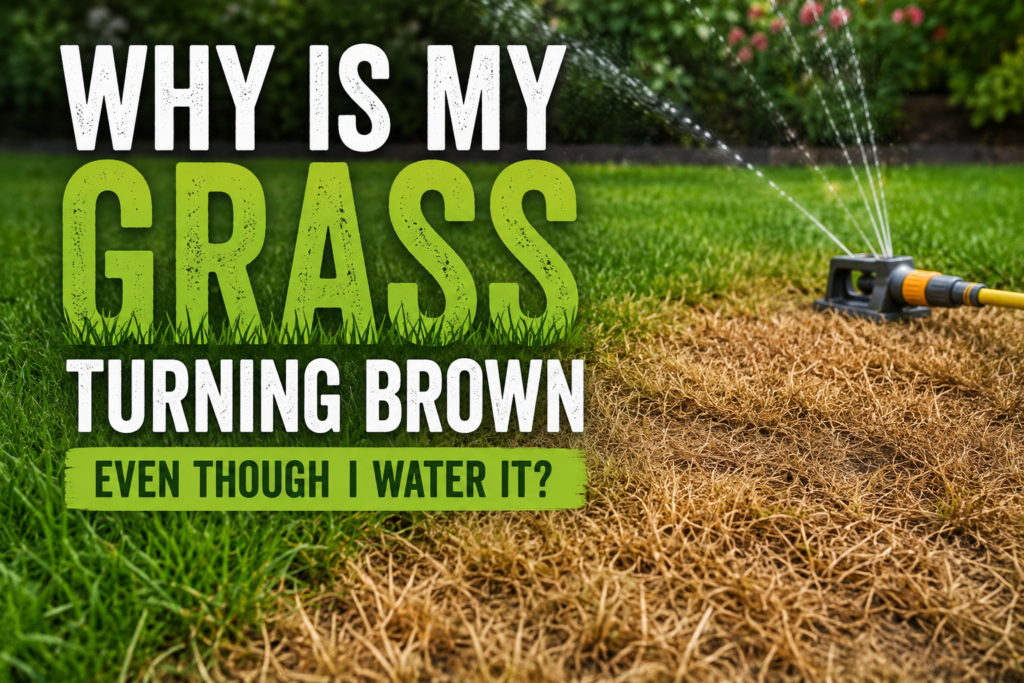
 Why Is My Grass Turning Brown Even Though I Water It?
You’re watering your lawn regularly, but instead of seeing thick, healthy green grass, you’re noticing brown patches—or maybe the entire lawn is starting to look dry.
It’s easy to assume your grass simply needs more water. But watering isn’t always the problem.
Before you increase your watering schedule, it’s important to figure out what your lawn is actually trying to tell you.
In this guide, we’ll look at some of the most common reasons grass turns brown even when you’re watering it—and what you can do to help your lawn recover.
1. You May Be Watering Too Often
This sounds strange, but watering your lawn frequently doesn’t necessarily mean your grass is getting the water it needs.
One of the most common mistakes homeowners make is watering for a short period every day.
Frequent, shallow watering encourages grass roots to stay close to the soil surface. Those shallow roots are more vulnerable to heat and drought.
Instead, most established lawns benefit from deeper, less frequent watering.
The goal is to encourage moisture to travel several inches into the soil so the roots grow deeper.
What to Do
Check the soil after watering.
Use a screwdriver or small garden tool and push it into the ground. If only the very top layer of soil is wet, you may need to water longer during each session.
Your lawn generally needs around 1 to 1.5 inches of water per week, including rainfall, although the exact amount varies depending on grass type, soil, weather, and local conditions.
2. Your Lawn May Not Be Getting Water Evenly
Your irrigation system may be running perfectly—and still missing parts of your lawn.
Sprinklers don’t always distribute water evenly.
Trees, landscaping, fences, wind, clogged sprinkler heads, poor sprinkler placement, and low water pressure can all create dry spots.
The result can be a lawn where some areas stay green while others turn brown.
Try the Cup Test
Place several empty tuna cans, small containers, or rain gauges around your lawn before running your sprinklers.
After watering, compare how much water collected in each container.
If one area receives significantly less water than another, you’ve probably found part of the problem.
Check your sprinkler heads for:
- Clogs
- Damage
- Incorrect positioning
- Poor spray patterns
- Low pressure
- Grass blocking the spray
Correcting uneven irrigation may solve your brown-grass problem without increasing your overall water use.
3. Hot Weather Can Stress Your Grass
Sometimes your watering routine isn’t necessarily wrong.
It’s just extremely hot.
During extended periods of high temperatures, grass can experience heat stress even when moisture is available.
Warm-season grasses generally tolerate summer heat better than cool-season varieties, but even grasses such as Bermuda, Zoysia, St. Augustine, and Bahia can struggle during extreme conditions.
Heat stress may cause grass to:
- Lose its bright green color
- Develop brown or yellow areas
- Wilt
- Grow more slowly
- Curl or fold its blades
Your lawn may simply be trying to conserve energy.
What to Do
Avoid trying to force stressed grass to grow aggressively.
Continue providing appropriate moisture, avoid excessive fertilizer, and limit unnecessary foot traffic during extreme heat.
4. You’re Watering at the Wrong Time of Day
Early morning is generally the best time to water your lawn.
Morning watering gives the soil time to absorb moisture before temperatures rise and evaporation increases.
Watering during the hottest part of the afternoon can waste water because more moisture evaporates before reaching the roots.
Late-night watering can create a different problem.
When grass stays wet for long periods overnight, conditions may become more favorable for certain lawn diseases.
For most lawns, watering sometime around early morning—roughly between 5 a.m. and 9 a.m.— is a good target.
5. You May Be Cutting Your Grass Too Short
Your mower could be contributing to your brown lawn.
Cutting grass extremely short removes much of the leaf surface the plant uses for photosynthesis. It can also expose the soil to more sunlight, increasing moisture loss.
This becomes particularly important during summer.
Different grass varieties have different ideal mowing heights.
For example, many St. Augustine lawns perform better when allowed to remain relatively tall, while Bermuda grass can generally tolerate much shorter mowing.
Follow the One-Third Rule
Try not to remove more than one-third of the grass blade during a single mowing.
If your lawn has grown taller than normal, gradually bring it back down rather than cutting it extremely short all at once.
And keep your mower blade sharp.
A dull mower blade tears grass instead of cutting it cleanly, leaving damaged tips that can make the lawn look brown.
6. Your Soil May Be Compacted
You can put plenty of water on your lawn and still have thirsty grass if the water can’t reach the roots.
Compacted soil makes it difficult for water, oxygen, and nutrients to move through the soil.
This commonly occurs in lawns with:
- Heavy foot traffic
- Children or pets frequently playing outside
- Vehicles or equipment crossing the lawn
- Heavy clay soil
- Years of soil compression
One sign of compaction is water pooling or running off the lawn instead of soaking into the ground.
The Screwdriver Test
Try pushing a screwdriver several inches into moist soil.
If it is unusually difficult to push into the ground, compaction could be part of the problem.
Core aeration can help relieve heavily compacted soil and improve water penetration.
7. Your Lawn Could Have a Fungus or Disease
Not every brown patch is caused by drought.
The exact diseases you’ll encounter depend heavily on your grass type, climate, temperature, moisture, and time of year.
Excess moisture can sometimes make disease problems worse.
That’s another reason why immediately increasing your watering isn’t always the right response.
Look closely at the affected grass.
You may notice:
- Circular or irregular brown patches
- Yellowing around the edges of patches
- Spots or discoloration on individual grass blades
- Grass thinning rather than simply drying
- Areas that continue spreading despite adequate moisture
If you suspect disease, identify the problem before applying a fungicide. Different diseases may require different treatment strategies.
8. Insects Could Be Damaging the Roots
Another possibility is that something is eating your lawn.
Lawn pests can damage grass blades, stems, or roots, causing areas of the lawn to turn yellow or brown.
Some pest damage looks almost identical to drought stress.
Check the Brown Areas
Inspect the boundary where healthy green grass meets the damaged area.
This transition zone is often a good place to look for active insects.
Also gently tug on the damaged grass.
If it pulls away from the soil unusually easily, root-feeding insects could be involved.
Correctly identify the pest before applying an insecticide. Treating your lawn unnecessarily wastes money and may harm beneficial insects.
9. Too Much Fertilizer Can Burn Your Lawn
Fertilizer helps grass grow—but more isn’t always better.
Applying excessive fertilizer can damage grass and create brown areas commonly referred to as fertilizer burn.
This is especially likely when too much fertilizer is concentrated in one area or when certain products are applied improperly during hot, dry conditions.
Fertilizer burn may appear as:
- Brown streaks
- Yellow patches
- Burned-looking grass
- Damage that appears shortly after fertilization
Always follow the application rate on the fertilizer label.
Using extra fertilizer won’t necessarily make your lawn greener faster.
It can do exactly the opposite. Check out this fertilizer that’s guaranteed not to burn your lawn.
10. Your Grass May Simply Be Dormant
Brown doesn’t always mean dead.
Grass can enter dormancy when growing conditions become unfavorable.
During dormancy, the grass slows its growth and may lose much of its green color while the crown and roots remain alive.
This is especially noticeable with warm-season grasses during colder months, although drought can also trigger dormancy.
Before replacing brown grass, determine whether it’s actually dead.
Dormant grass may recover when favorable temperatures and moisture return.
How Do You Know What’s Causing Your Brown Grass?
Because several lawn problems look similar, don’t diagnose your lawn based on color alone.
Start with the simplest possibilities.
Ask yourself:
- Is the soil actually moist several inches below the surface?
- Are all areas of the lawn receiving roughly the same amount of water?
- Have temperatures been unusually hot?
- Am I mowing too short?
- Does water soak into the soil or run off?
- Do I see insects or unusual damage near the brown patches?
- Do the grass blades show signs of disease?
- Did the problem begin after fertilizing?
- Could my grass simply be entering dormancy?
Working through these questions can help you narrow down the problem before spending money on treatments your lawn may not need.
Should You Water Brown Grass More?
Not automatically.
This is one of the most important things to remember.
If your grass is brown because the soil is dry, additional water may be exactly what it needs.
But if the problem is caused by fungus, overwatering, insects, compacted soil, fertilizer damage, or another issue, adding more water may accomplish very little—and could potentially make the problem worse.
Check the soil first.
If the root zone is already moist, investigate other causes before increasing your watering schedule.
Can Brown Grass Turn Green Again?
Often, yes.
If the crown and roots of the grass are still healthy, the lawn may recover once you correct the underlying problem.
How quickly it recovers depends on the cause and severity of the damage.
Mild drought or heat stress may improve relatively quickly once conditions improve. Severe insect, disease, fertilizer, or root damage may require more extensive repair.
Some areas may eventually need to be reseeded, plugged, or resodded if the grass has died completely.
Final Thoughts
Seeing brown grass after you’ve been faithfully watering your lawn can be frustrating.
But more water isn’t always the answer.
Start by checking whether water is actually reaching the root zone and whether your sprinklers are covering the lawn evenly. Then look at mowing height, soil compaction, heat stress, fertilizer use, insects, and possible disease.
The key is identifying why the grass is turning brown before trying to fix it.
Once you understand the cause, you’ll have a much better chance of getting your lawn healthy, green, and growing again.
And remember: a healthy lawn isn’t necessarily the lawn that receives the most water.
It’s the lawn that gets the right amount of water at the right time—and the right care everywhere else.